API Reference
Siteverify
Server-side token validation endpoint.
Verification flow
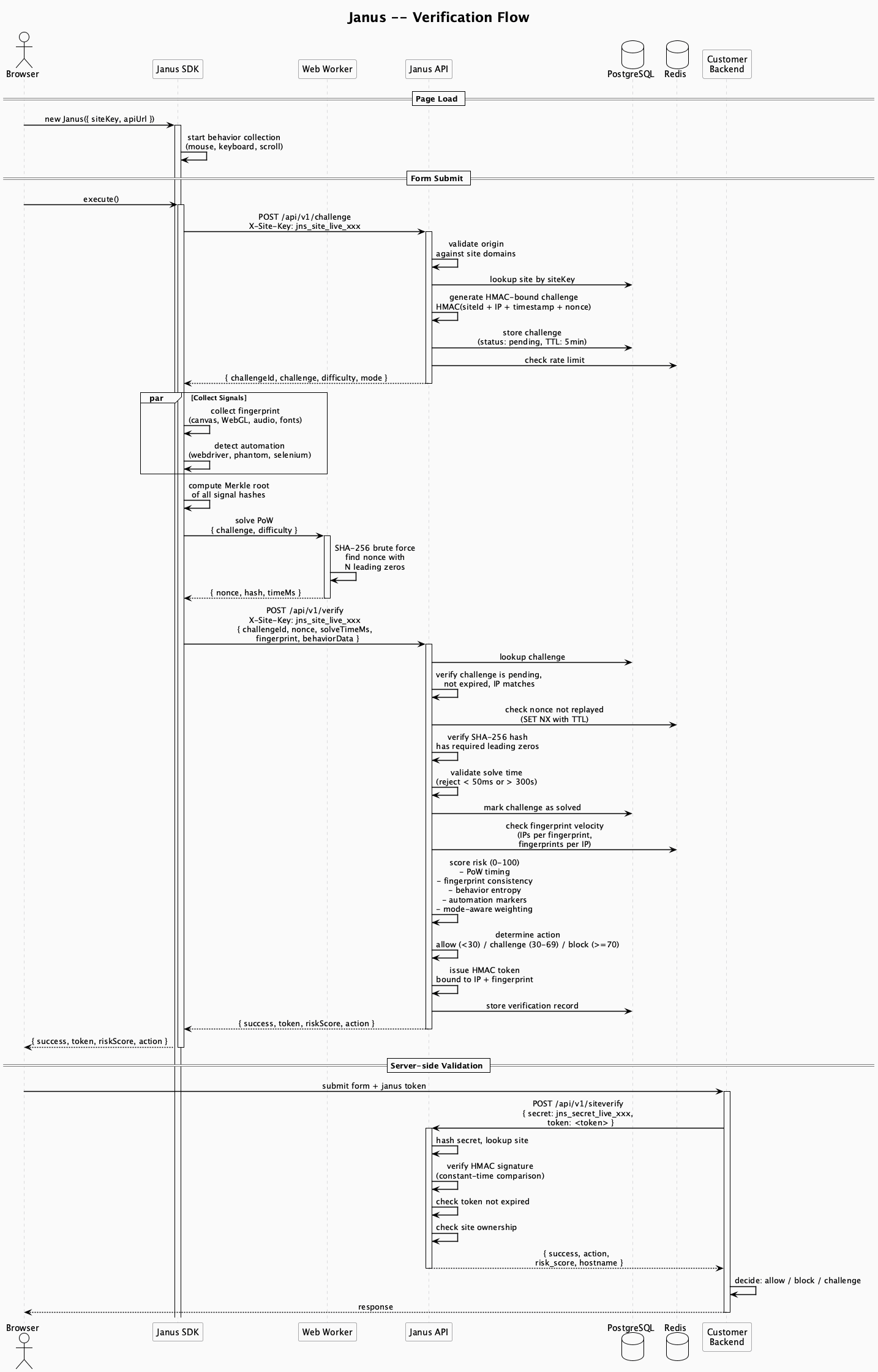
POST /api/v1/siteverify
Validates a Janus verification token. Called from your backend after receiving the token from the client.
Request
{
  "secret": "jns_secret_live_xxxxxxxxxxxx",
  "token": "token-from-client",
  "remoteip": "1.2.3.4"  // optional
}| Field | Required | Description |
|---|---|---|
secret | Yes | Your site secret key |
token | Yes | Token received from the client SDK |
remoteip | No | Client IP — if provided, must match the IP used during verification |
Success response
{
  "success": true,
  "challenge_ts": "2026-03-22T10:00:00.000Z",
  "hostname": "example.com",
  "action": "allow",
  "risk_score": 15
}
Error response
{
  "success": false,
  "error": "Token has expired",
  "error-codes": ["token-expired"]
}
Error codes
| Code | Meaning |
|---|---|
token-expired | Token TTL (5 minutes) exceeded |
token-invalid | HMAC signature verification failed |
ip-mismatch | remoteip doesn't match verification IP |
site-mismatch | Token was issued for a different site |
Integration examples
Using @janus-bot/express:
app.post('/submit', janusVerify({ secretKey, apiUrl }), handler);Using @janus-bot/nextjs:
const result = await verifyJanusToken(token, { secretKey, apiUrl });Using fetch directly:
const res = await fetch(`${apiUrl}/api/v1/siteverify`, {
  method: 'POST',
  headers: { 'Content-Type': 'application/json' },
  body: JSON.stringify({ secret: secretKey, token }),
});
const { success, action, risk_score } = await res.json();